 |
Miscellaneous
Birdwatching spots in Teesside |
The
Teesside area has a good mixture of habitats, although there
are some gaps. The habitat we really lack is mature deciduous
woodland, especially Oak. There are pockets of this precious
habitat but not enough to hold good populations of species
like Wood Warbler, Pied Flycatcher, Redstart etc.
| Woodland
in the Teesside area tends to be in small pockets. In
the south of the area the semi-natural woodland tends
to be in the steep valleys running down to the sea. Most
of the rest of the tree cover has been planted during
the last 100 years or so. Very old trees (such as Oak)
are quite rare in our area as most mature trees were
either used for fuel or for materials used in the Ironstone
industry during the last 200 years.
A
good place to look for woodland species is Saltburn
woods, which holds quite a variety of typical species
such as Great Spotted and Green Woodpeckers and in
the past Lesser Spotted Woodpecker (which is very
rare in Teesside). Also Hawfinch, Dipper, Grey Wagtail,
Nuthatch, Blackcap, Garden Warbler, Chiff Chaff and
Willow Warbler. |
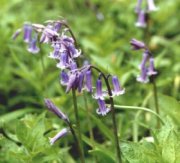
| Bluebells Hyacinthoides
non-scripta |
|
Some
woodland species are rather difficult to find in
the breeding season such as Pied Flycatcher and Redstart.
They are spread very thinly in this area. The woods
at the base of Roseberry Topping do offer one of
the best chances to find Redstart, although Pied
Flycatcher is more illusive. Coniferous forest is
more widespread around Teesside and does give the
habitat needed for species such as Goldcrest, Siskin,
Redpoll, Crossbill, Sparrowhawk and Goshawk. More
unusual species seen in the forests have included
Nightjar and Parrot Crossbill .
Apart
from the North Tees marshes and Coatham marsh, the
amount of open water in Teesside is small. This gives
small ponds and patches of open water more significance.
Hemlington lake has built up quite a species list
since it was built. It is most noticable for passage
birds such as terns, ducks and the occasional Osprey.
The most famous pond in our area must be Charlton's
pond in Billingham, this small pond has had a wide
variety of birds such as Black-Throated Diver, Ring-Necked
Parakeet (now called Rose-Ringed Parakeet) and the
most famous of all, the first British record of Double-Crested
Cormorant.
|
 |
| |
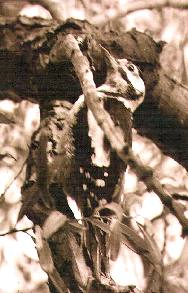
Great
Spotted Woodpecker
Dendrocopos
major |
| |
|
|
|
|